
-
 Shield
Bamileke shield Sabo
Price range: 109,00 € through 237,00 € This product has multiple variants. The options may be chosen on the product page -
 Stool
StoolRoyal Beaded Bamileke Elephant Stool Black White Red
Price range: 519,00 € through 1039,00 € This product has multiple variants. The options may be chosen on the product page
Whether you collect, curate, or design spaces, choosing African decorative arts should feel as considered as placing them in your interior. Provenance and authenticity are not only about price or prestige. They are how you respect the culture, the maker, and the story your piece will carry into a contemporary home or hospitality space.
Why provenance matters in African decorative arts
Story, value, and responsibility
Provenance is the documented journey of a piece – who made it, where, when, for what purpose, and how it moved from its community to you. Strong provenance preserves cultural context, supports fair compensation for artisans, and anchors long-term value. For collectors, it reduces uncertainty. For design professionals, it gives clients confidence and a narrative they are proud to share.
What authentic looks and feels like: materials and making
Wood, fibers, beads, and finishes
Many emblematic pieces – from Bamiléké stools and shields to Juju Hats and beaded heads – are crafted in hardwoods, plant fibers, feathers, and glass beads. Authentic works usually show smart, resourceful use of local materials: dense timber with varied grain, hand-woven or stitched fiber understructures, natural-feeling feather layering, and beadwork attached on fabric or clay with subtle irregularity.
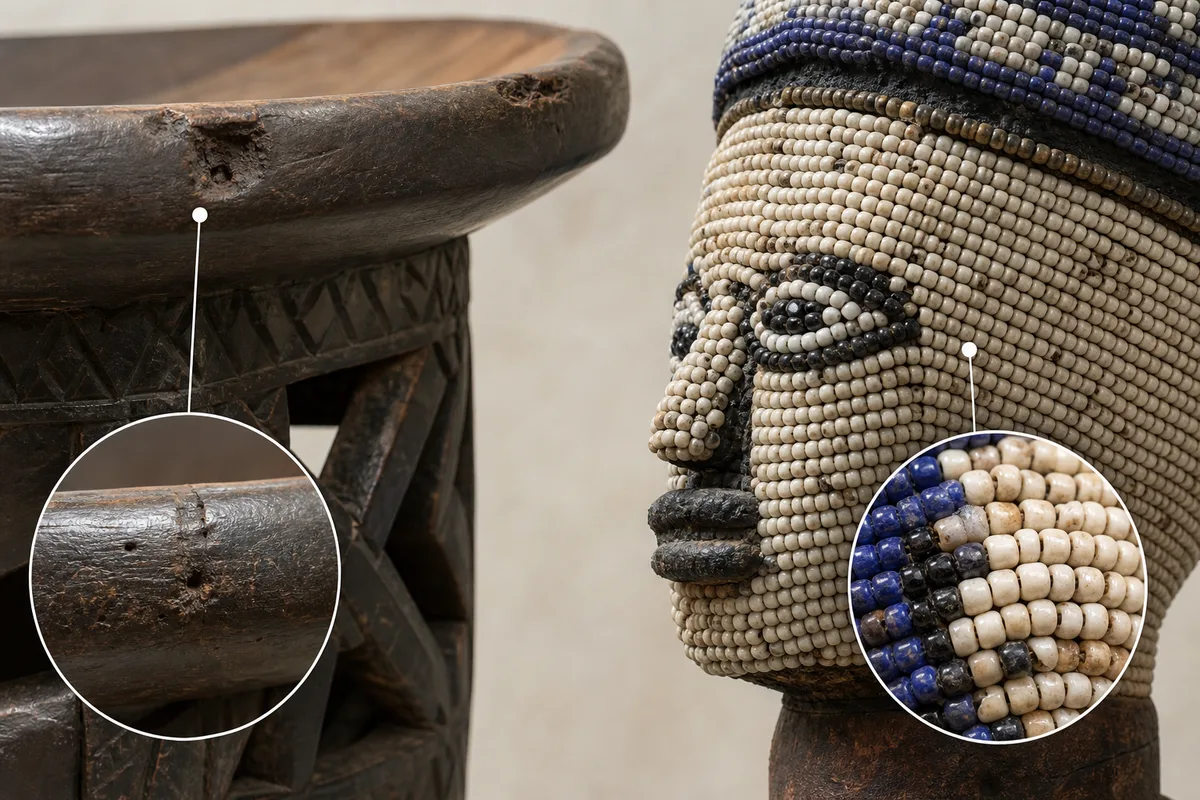
- Surface tells a story: gentle tool marks on carved forms, slight variance in bead spacing, or small color shifts where natural dyes were used.
- Structure matters: the underside of a Bamiléké stool, for example, is typically cleanly carved yet not perfectly machined; handmade armatures on beaded heads reveal thread paths or compound layers.
- Finishes are lived-in, not plastic: waxed, oiled, or burnished surfaces feel dry-satiny rather than glossy lacquer; feathers appear layered, not sprayed or glued flat.
Signs of handwork vs mass production
Handmade pieces breathe with variation. Identical twins suggest factory molds. Look at hidden zones: the inside of a mask, the underside of a stool, or the back of a wall piece. Machine-made items often show uniform milling, sprayed finishes, or synthetic glues that pool and shine. Authentic handwork tends to balance symmetry with tiny deviations and a tactile finish that has softened over time.
Reading age and use with care
Honest wear and natural patina
Age is not a guess. It is a series of clues that agree with one another. Honest wear appears where hands actually touch or where gravity acts: seat tops polished smoother than the sides, softened edges at rims, micro-cracks along wood grain, slight darkening around grip points, or feather bases a shade deeper than their tips.
- Oxidation is gradual: iron elements show layered browns rather than uniform paint-like rust.
- Residues make sense: smoke-darkening appears in recesses or interior cavities, not in flat, exposed zones only.
- Repairs tell time: old, neat repairs may use natural fibers or wood insets; new repairs are fine too when disclosed.
Red flags of artificial aging
- Identical, round wormholes with no internal dust or paths.
- Perfectly even patina in every crevice, suggesting spray or chemical staining.
- Edges sanded evenly all around with powder still present.
- Strong chemical or petroleum smell that lingers on surfaces.
- Stories that lean on age but cannot provide any supporting details.
Documentation you can request
The provenance trail
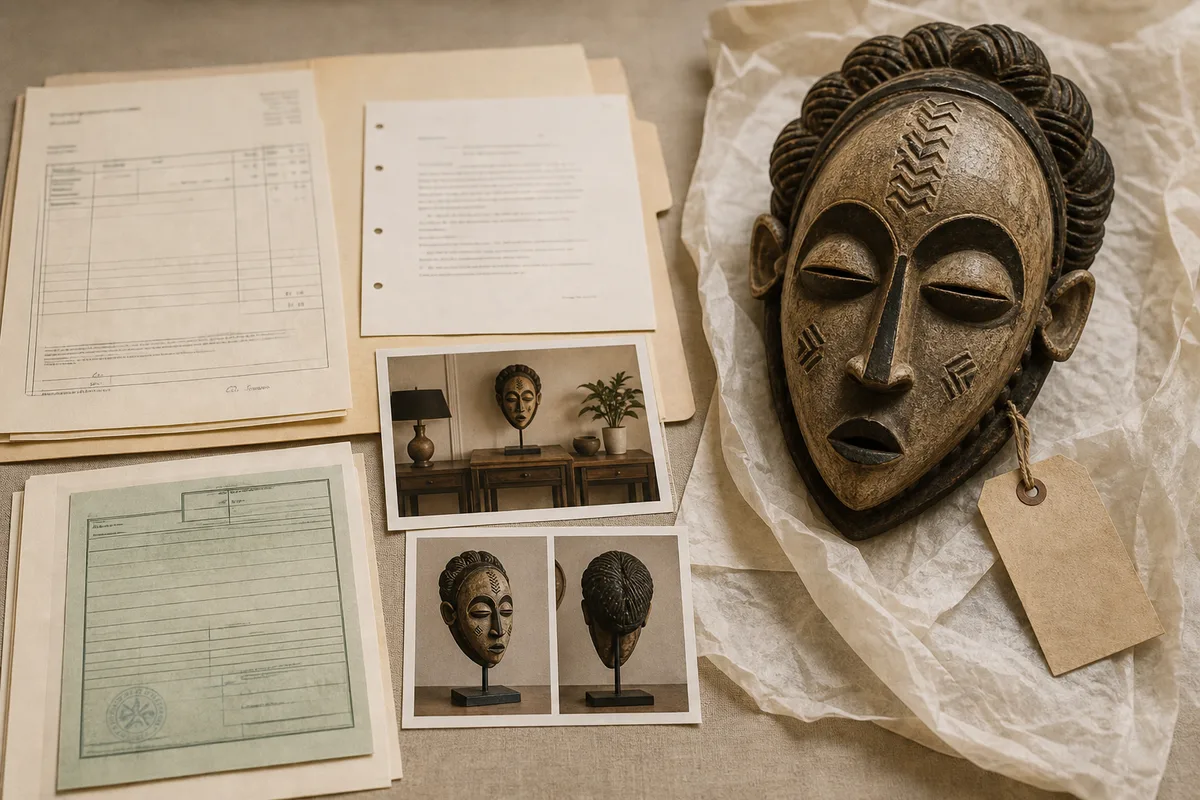
Ask for a simple dossier. It does not need to be elaborate. A clear paper trail builds trust and helps future caretakers of the piece.
- Seller invoice with full contact details and a description that matches the piece.
- Origin details: community, region, and date or period of making (estimate if exact is unknown).
- Artisan or workshop name when known, or sourcing partner and their role.
- Acquisition history: how and when it left the source community and prior owners if applicable.
- Studio or in-situ photos, even informal, that predate the sale.
- Any restoration notes and who performed them.
- Export or transfer permits where applicable to the country of origin and destination.
Authenticity support, not absolutes
Certificates can support a claim, but no single document replaces careful inspection and a consistent story. Trust is cumulative: materials and making align with the stated origin, wear matches use, documentation is traceable, and the seller answers with clarity.
Ethical sourcing: questions that protect culture and maker
Ethics are part of authenticity. Prefer pieces made for sale by artisans or released appropriately by their communities. Avoid items with signs of active ceremonial use offered without formal release or paperwork. Ensure fair pay for makers, transparent sourcing, and respect for local regulations. Responsible choices honor heritage while supporting living craftsmanship.
- Was this piece made for the market or deaccessioned appropriately?
- Were artisans or owners paid fairly and directly?
- Are there cultural restrictions on sale or export for this type of object?
- Does the seller have or provide required permits where applicable?
- Are restorations or alterations clearly disclosed?
The practical checklist: questions to ask any seller
- Who made it, and where exactly was it made? If unknown, what is the best-supported attribution?
- When was it made? What evidence supports the age estimate?
- What materials and techniques were used? Any synthetic components?
- How and when did you acquire it? Can you describe the chain of custody?
- Do you have photos of the piece before it reached your gallery or shop?
- Has it been restored or cleaned? By whom and to what extent?
- What documentation comes with the piece today?
- Are any permits or declarations required for this type of object, and are they included?
- What are the exact dimensions and weight? How is it mounted or installed?
- For multiples or commissions, what are lead times and how consistent are finishes?
- What is the return policy if the piece is materially misdescribed?
- How should the piece be cared for in a home, hotel, or retail environment?
For designers and hoteliers: project-ready due diligence
When a piece must work hard in a public space, add practical checks so beauty meets reliability.
- Confirm scale, weight, and safe mounting for walls or ceilings, especially for Juju Hats and large shields.
- Discuss finish durability and cleaning in hospitality settings; request a care sheet.
- Check fire-safety implications for feathered or fiber pieces and agree on placement guidelines.
- For multiples, agree on acceptable variance and create a reference sample.
- Plan logistics: lead times, packing methods, and replacement options if a piece is damaged in transit.
- Align on documentation you will pass to your client, including a concise provenance summary.
-
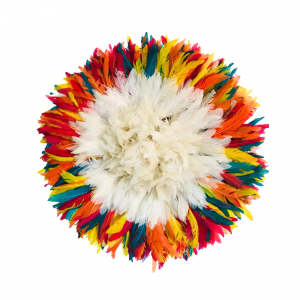 Juju Hat
Juju hat white rainbow border
Price range: 127,00 € through 255,00 € This product has multiple variants. The options may be chosen on the product page -
 Shield
Bamileke shield Galo
Price range: 109,00 € through 237,00 € This product has multiple variants. The options may be chosen on the product page -
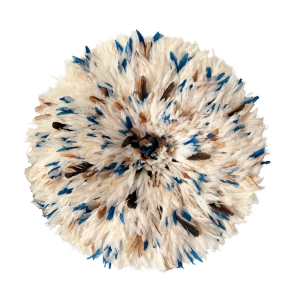 Juju Hat
Juju hat white speckled brown blue
Price range: 127,00 € through 255,00 € This product has multiple variants. The options may be chosen on the product page